o
p
t
i
m
a
r
o
b
o
t
i
c
s

Make a Call


Make a Call
Blogs
2026 How to Choose a Police Drone Detector?
Choosing a Police Drone Detector in 2026 requires more than comparing detection ranges.
A reliable system must identify genuine drone activity near stations, prisons, airports, and public events.
It should also reduce false alarms from birds, helicopters, weather, and nearby construction equipment.
Dr. Todd Humphreys, a respected drone-security researcher, has described a drone as “a flying computer with wings.”
That observation matters when evaluating modern detection technology.
A capable Police Drone Detector may combine radio-frequency monitoring, radar, optical cameras, and acoustic sensors.
Each method has strengths.
None is perfect.
In practical testing, officers should examine detection distance, sensor coverage, alert speed, and performance in rain or crowded urban areas.
A clear dashboard matters.
So does secure data handling.
The system should preserve timestamps, signal details, and camera evidence without creating unnecessary privacy risks.
Buyers must also confirm training requirements, maintenance costs, software updates, and compatibility with existing communication systems.
Experience in the field can reveal weaknesses that brochures hide.
A detector may perform well over open ground but struggle beside concrete buildings.
It may recognize a common model quickly, then miss an unfamiliar design.
That is where careful trials become essential.
Do not trust one impressive demonstration.
The best choice supports lawful monitoring, responsible reporting, and measured human decisions.
Detection is not the same as identification.
It is not proof of intent.
This guide explains how to compare a Police Drone Detector by evidence, reliability, and operational fit.
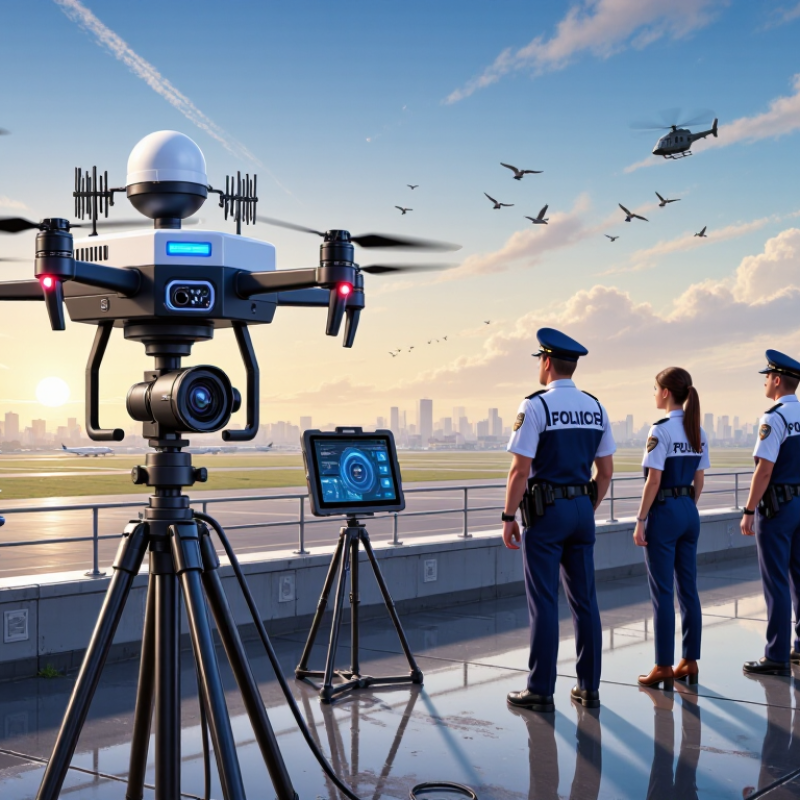
Table of Contents [Hide]
Define the Police Mission: Detect, Identify, Track, or Mitigate
2026 How to Choose a Police Drone Detector?
Define the Police Mission: Detect, Identify, Track, or Mitigate
A police drone detector should match the mission, not merely display impressive technical data. Detection means discovering an aerial signal or object near a protected area. This requires dependable coverage, clear alerts, and performance during rain, traffic, and crowded radio environments.
An operator may need to know only that activity exists. That decision saves time.
Identification
Identification requires more evidence. The system should help distinguish a drone from ordinary wireless equipment, birds, or aircraft. Useful tools may show signal characteristics, direction, approximate location, and confidence levels.
These results should support trained personnel, not replace them. Human review remains essential when conditions are uncertain.
Tracking
Tracking demands continuity. Officers need a stable timeline, mapped movement, and reliable time stamps for lawful incident records. Test the detector around buildings, trees, and changing weather. Laboratory claims can feel distant from a stadium entrance. Very distant.
Mitigation
Mitigation should mean an authorized, proportionate response, such as notifying personnel, securing an area, or coordinating with aviation authorities. Do not assume every alert justifies intervention.
Procurement teams should request field demonstrations, maintenance details, calibration procedures, data protection controls, and operator training. Ask how false alarms are recorded and corrected. That question matters.
No detector performs perfectly. A system that admits uncertainty may support better decisions than one that hides it.
Review local policies, permissions, and evidence requirements before deployment. Metrics should reflect the real mission: faster awareness, accurate identification, safer tracking, or clearer coordination.
Brands
Proudly Trusted by Top Suppliers Worldwide






Let us know and we will automate, together to fit your industrial needs.
 +91-97254 16844
Clients
Proudly Trusted by Top Companies Worldwide


Do you need Help? Get in touch.
X
Please fill out the form below and we will get back to you as soon as possible.