o
p
t
i
m
a
r
o
b
o
t
i
c
s

Make a Call


Make a Call
Blogs
What Are the 7 Best Epoxy Resin 3D Printing Options?
Choosing the right resin system can change a small prototype from cloudy and brittle to sharp, durable, and dependable. This guide examines seven promising Epoxy Resin 3d Printing options for makers, engineers, designers, and small production teams. Each option is considered through practical details, not attractive specifications alone.
The comparison focuses on print resolution, resin compatibility, curing control, surface quality, strength, odor, cleanup, and total operating cost. A printer may produce 25-micron layers, yet poor calibration can leave support marks across a delicate gear. Another system may print quickly but require longer post-curing. Those differences matter on a real workbench.
Testing should include dimensional accuracy, impact resistance, heat exposure, and repeated handling. Manufacturer data provides useful direction, but independent tests reveal weaknesses. Resin viscosity, ambient temperature, and washing methods can change results. Even experienced users occasionally overexpose a model or snap thin supports. That is part of the learning curve.
The seven options below are not ranked by marketing claims alone. They are assessed for realistic workshop use, material availability, maintenance demands, and safety practices. Proper ventilation, protective gloves, eye protection, and responsible waste handling remain essential. No single choice fits every project. A dental pattern, functional enclosure, and decorative miniature need different priorities.
Some conclusions may change as formulations improve. That uncertainty deserves attention. A careful buyer should confirm current specifications, compatibility, warranty terms, and regional availability before purchasing. Practical evidence matters more than impressive photographs.
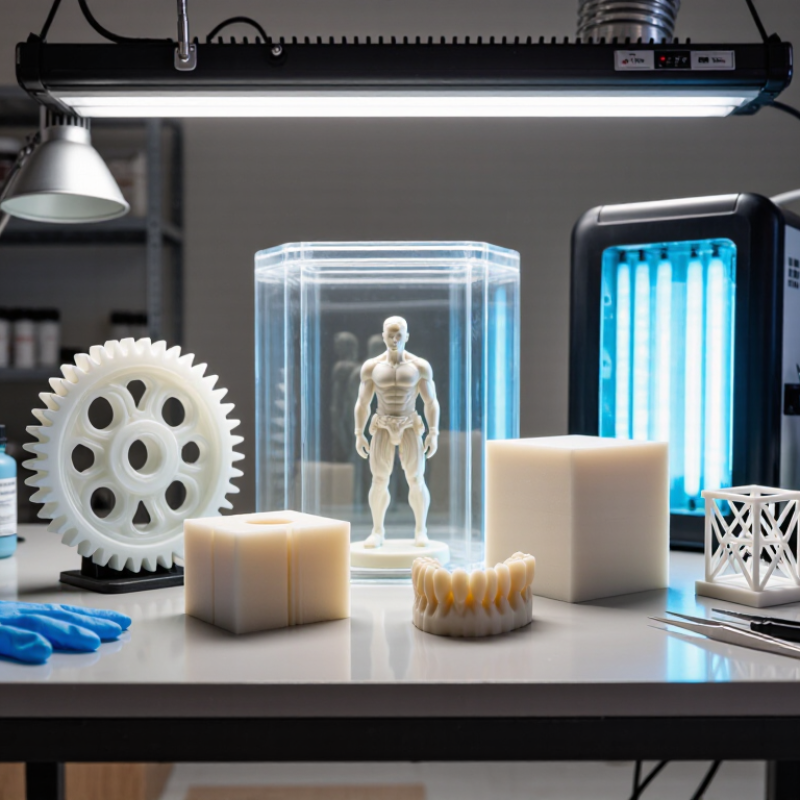
Table of Contents [Hide]
What Is Epoxy Resin 3D Printing?
Epoxy resin 3D printing uses liquid, light-sensitive resin to build objects layer by layer. A UV laser, projector, or masked screen cures each layer. The resin usually contains epoxy-related polymers, reactive diluents, pigments, and photoinitiators. It is not ordinary epoxy. Traditional epoxy hardens after mixing two components, while photopolymer resin cures through controlled light exposure.
The process can produce sharp lettering, smooth curves, and small holes with impressive accuracy. SLA, DLP, and MSLA systems are common options within the seven main resin-printing choices. In a practical test, a 0.05-millimeter layer can show fine surface detail, but exposure settings still change results.
Too much exposure creates swollen edges. Too little exposure leaves weak, tacky surfaces. Details matter.
Industry demand supports this interest. The Wohlers Report 2024 valued the global additive manufacturing industry at 20.035 billion dollars in 2023, after 13.5% growth. Fortune Business Insights estimated the 3D-printing materials market at about 2.99 billion dollars that year.
These figures cover broader technologies, not epoxy resin alone, so they should not be treated as direct resin-market proof. That distinction is easy to miss. ASTM and ISO terminology also classify materials by process, not simply by marketing names.
Users should check technical data sheets for tensile strength, heat resistance, shrinkage, and post-curing requirements.
Ventilation, gloves, eye protection, and complete curing remain essential because uncured resin can irritate skin. A glossy print may look finished. It may not be.
Brands
Proudly Trusted by Top Suppliers Worldwide







Let us know and we will automate, together to fit your industrial needs.
 +91-97254 16844
Clients
Proudly Trusted by Top Companies Worldwide


Do you need Help? Get in touch.
X
Please fill out the form below and we will get back to you as soon as possible.