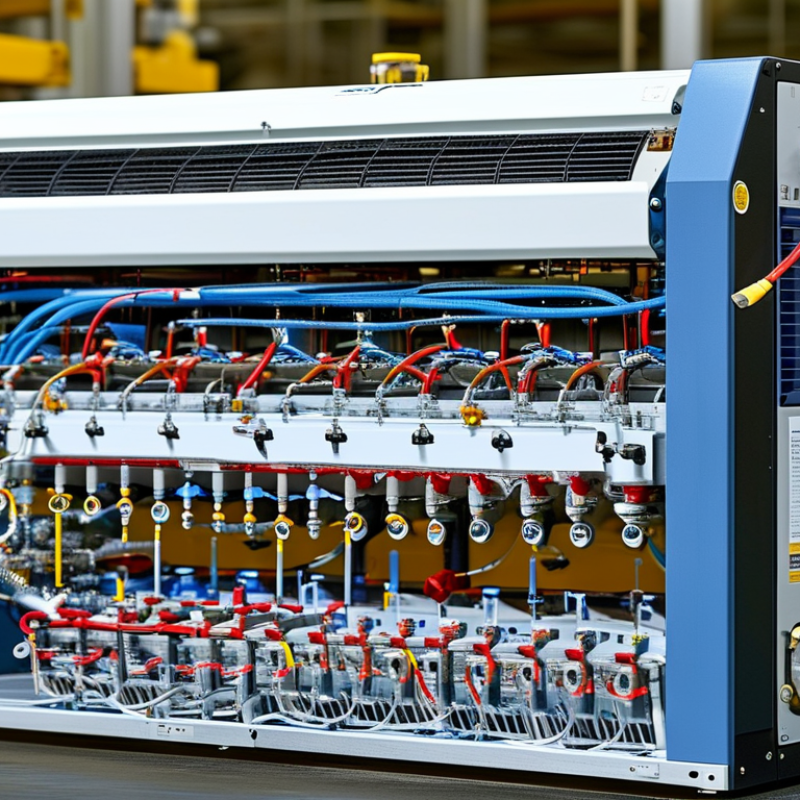
| What is an RO plant water chiller? | A packaged cooling system that removes heat from RO feed water, permeate, product water, or a related process loop before the water enters a temperature-sensitive process. | Usually consists of a refrigeration circuit, heat exchanger, circulation pump, controls, sensors, and safety protection. | Select the chiller according to actual flow, inlet temperature, required outlet temperature, ambient conditions, and water chemistry. | Confirm whether the equipment is intended for potable water, industrial process water, wastewater, or a closed-loop application. |
| Cooling capacity | The rate at which the unit removes heat from the water stream. | Common small and medium systems: approximately 3–350 kW; larger installations may require multiple modules or central chilled-water systems. | Size from the calculated heat load rather than from RO membrane capacity alone. Include heat from pumps, tanks, pipes, and the surrounding environment. | Request rated capacity at the actual design water temperature and local ambient temperature. |
| Water flow rate | The volume of water passing through the evaporator or process heat exchanger per unit of time. | Typical packaged units may handle about 0.5–70 m³/h, depending on cooling capacity and temperature difference. | Use the continuous operating flow, not only the peak flow. Check minimum and maximum flow limits to prevent poor heat transfer or freezing. | Confirm connection size, pump head, flow switch requirements, and compatibility with metric or imperial piping. |
| Inlet and outlet temperature | The temperature reduction required across the chiller. | Many process-water applications use an inlet range of approximately 15–35°C and an outlet range of approximately 5–25°C. | Specify both temperatures and the required stability. Do not select only by nominal setpoint. | Check performance at the hottest seasonal inlet condition and the lowest permitted outlet temperature. |
| Temperature stability | The ability to maintain a consistent water temperature during changing RO demand. | Standard control may maintain approximately ±1–2°C; tighter control requires suitable sensors, control valves, and a buffer tank. | Choose tighter control only when membrane performance or downstream production genuinely requires it. | Ask for control accuracy, sensor location, response time, and operating data under partial load. |
| Cooling method | How heat is rejected from the refrigerant to the surrounding environment. | Air-cooled: simple installation and no cooling tower water. Water-cooled: generally more compact and efficient where a reliable cooling-water system is available. | Use air-cooled units where water conservation and simple installation are priorities; consider water-cooled units for large, continuous-duty plants. | Evaluate ambient temperature, water availability, fouling risk, noise limits, and maintenance capability. |
| Water-side materials | Materials that contact feed water, permeate, concentrate, or process water. | Common choices include stainless steel, titanium, copper-nickel, coated carbon steel, and engineered plastics, depending on chemistry. | Match materials to chloride level, pH, conductivity, disinfectants, temperature, and cleaning chemicals. | Request material certificates and corrosion guidance for the exact water analysis. |
| Refrigerant considerations | The refrigerant affects energy use, service requirements, safety classification, and environmental impact. | Refrigerants differ by global phase-down rules, global warming potential, flammability, operating pressure, and technician availability. | Prioritize legally permitted refrigerants, trained service support, leak protection, and long-term availability. | Verify compliance with the destination country’s refrigerant regulations and import requirements before ordering. |
| Energy efficiency | The cooling output delivered relative to electrical input. | Efficiency varies significantly with load, temperatures, compressor type, condenser condition, and fan or pump control. | Compare COP or EER at identical entering and leaving water temperatures, not only at standard laboratory conditions. | Request full-load and part-load power data, standby consumption, and annual energy estimates. |
| Electrical compatibility | The power supply required by the compressor, pump, fans, controls, and auxiliary equipment. | Common industrial supplies include 220–240 V or 380–415 V, three-phase, 50 or 60 Hz; exact requirements vary by location. | Specify voltage, phase, frequency, starting method, short-circuit rating, and acceptable voltage tolerance. | Confirm local electrical certification, control-panel language, cable standards, and power-factor requirements. |
| Operating environment | The ambient conditions in which the chiller must operate reliably. | Standard equipment may be designed for approximately 5–40°C ambient; high-ambient versions are needed for hotter climates. | Allow for altitude, humidity, dust, salt air, outdoor exposure, and seasonal temperature extremes. | Check enclosure rating, corrosion protection, ventilation clearance, rain protection, and derating at altitude. |
| Control and integration | The interface between the chiller and the RO plant control system. | Typical functions include temperature control, flow protection, high and low pressure protection, anti-freeze protection, alarms, and remote start/stop. | Choose a controller that supports dry contacts or the required industrial communication protocol. | Confirm alarm outputs, data logging, remote monitoring, cybersecurity requirements, and language options. |
| Filtration and water quality | Particles, scale-forming minerals, biological growth, and chemicals can reduce heat-transfer performance or damage components. | The required pretreatment depends on turbidity, hardness, iron, silica, chloride, total dissolved solids, and cleaning regime. | Install appropriate strainers, filters, chemical treatment, or a closed loop where necessary. | Provide a current water analysis and define cleaning intervals before final equipment selection. |
| Noise and vibration | Compressor, condenser fan, pump, and pipe vibration may affect workers, laboratories, or nearby buildings. | Noise varies by compressor type, fan speed, enclosure, and installation; published sound-pressure values must state the measurement distance. | Use variable-speed fans, acoustic treatment, vibration isolators, or remote installation where needed. | Request sound data, foundation requirements, service clearances, and permitted operating hours. |
| Installation footprint | The floor area, height, access space, and lifting arrangements required for installation and maintenance. | Compact packaged units may be skid-mounted; larger units can require separate pumps, tanks, filters, and heat-rejection equipment. | Review the complete system layout, not just the chiller dimensions. | Confirm shipping dimensions, operating weight, lifting points, door access, and local foundation design. |
| Maintenance requirements | Routine work needed to preserve cooling capacity, efficiency, water quality, and safe operation. | Typical tasks include filter inspection, condenser cleaning, leak checks, electrical inspection, sensor calibration, and heat-exchanger cleaning. | Select accessible components and establish preventive maintenance intervals based on operating hours and water quality. | Check spare-parts availability, service manuals, technician training, warranty terms, and response time. |
| Best overall selection approach for 2026 | The most suitable RO plant water chiller is not necessarily the largest or lowest-cost unit; it is the one that meets verified thermal, electrical, environmental, regulatory, and service requirements. | A complete specification should include cooling capacity, flow, temperatures, water chemistry, ambient conditions, electrical supply, controls, materials, sound level, and documentation. | Compare at least three technically equivalent quotations using the same design conditions and total ownership cost. | Obtain performance data, compliance documents, installation drawings, commissioning procedures, and lifecycle cost information before purchase. |