o p t i m a r o b o t i c s

Blogs

10 Best Robot Programming Languages for Industrial Robots?

Industrial robots rarely fail because of motors alone. Their performance depends on clear instructions, reliable timing, and safe communication with surrounding equipment. Robot programming connects these elements, turning a digital routine into precise movement on a factory floor.

This guide examines 10 best robot programming languages for industrial robots, including vendor-specific languages, PLC-oriented systems, and widely used general-purpose options. Each language offers practical strengths. Some simplify motion commands, while others support vision systems, sensors, simulation, or production data. A technician adjusting a welding path may value simplicity. An automation engineer integrating conveyors may need flexible communication and diagnostics instead.

Real factory conditions are less tidy than training examples. Dust, tool wear, network delays, and small calibration errors can change results. A language that looks powerful on paper may feel difficult during a twelve-hour maintenance shift. That distinction matters. The comparison considers learning effort, controller compatibility, debugging, safety support, scalability, and industrial adoption. It also recognizes that no single language fits every robot cell. Experienced teams still test assumptions, document changes, and review programs before deployment. Mistakes happen. Careful review reduces their cost. The goal is not to name one universal winner, but to help readers choose a dependable approach for their equipment, workforce, and production goals.
10 Best Robot Programming Languages for Industrial Robots?

What Are Robot Programming Languages and Why Do Industrial Robots Need Them?

Industrial robot programming languages are the instructions that turn a production plan into controlled movement. They tell a robot where to move, how fast to travel, and when to activate a tool. Some systems use text-based code, while others rely on teach pendants, graphical commands, or controller-specific scripts. These methods may look different, but they share one purpose: making physical work repeatable.

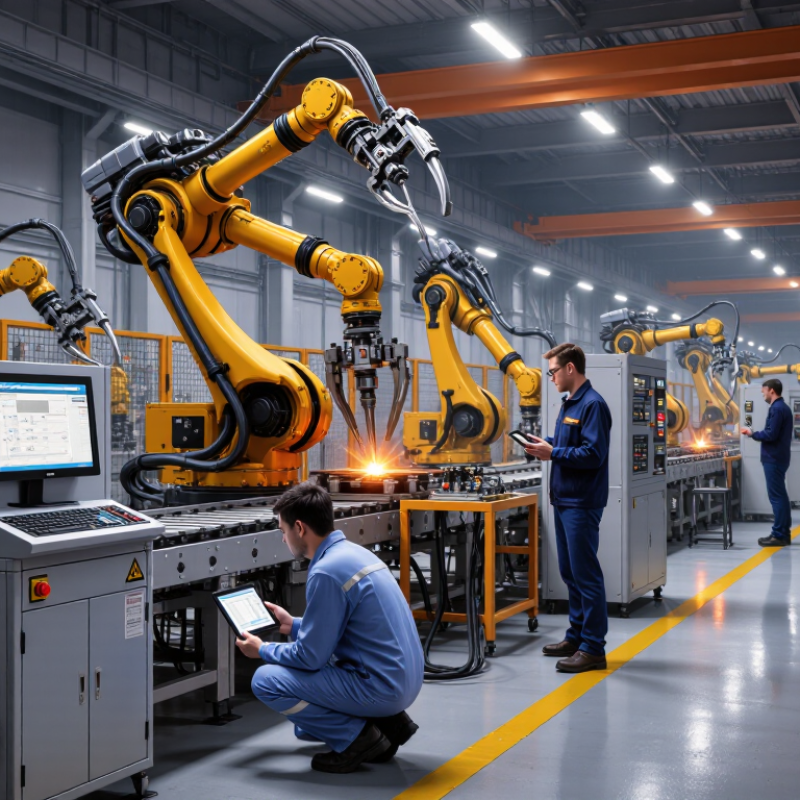
A programmer might record points around a metal frame, set a welding path, and add checks for position or tool status. The controller then converts those commands into coordinated motion across several joints. Small details matter. A few millimeters can affect a finished part. A poorly timed gripper signal can stop an entire cell. Practical testing is essential, because software behavior can change when payload, speed, or fixture conditions change.

Industrial robots need programming languages for more than movement. They support communication with sensors, conveyors, safety systems, and quality equipment. They also help technicians adjust a process without rebuilding every instruction. Clear code makes troubleshooting less stressful during a night shift. Still, no language removes human responsibility. A rushed program may pass one test and fail after maintenance. I have found that simple comments, measured speeds, and documented recovery steps prevent expensive confusion. The imperfect part is unavoidable: every application needs retesting when tools, materials, or workspace conditions change.

Key Factors for Choosing a Language for Industrial Robot Programming

10 Best Robot Programming Languages for Industrial Robots?

Choosing a language starts with the robot cell, not personal preference. The International Federation of Robotics reported 541,302 industrial robot installations in 2023. That scale makes maintainability a production concern. A suitable language should support motion control, sensor integration, diagnostics, and safe recovery after faults.

Robot-specific languages often simplify teaching, sequencing, and motion commands. IEC 61131-3 languages fit programmable controllers and may reduce training gaps. C++ offers detailed hardware control, while Python supports vision, data analysis, and rapid testing. Java can help with larger software systems, but its deployment overhead may challenge small cells. These are not equal choices.

Measure the practical cost.

Evaluate cycle-time stability, debugging speed, offline simulation, library access, and technician training. A language that saves two hours during development may create weeks of troubleshooting later. The World Economic Forum’s Future of Jobs Report 2023 predicts that 44% of workers’ core skills will change by 2027. Training capacity therefore matters as much as syntax. In commissioning work, clear error messages often beat elegant code. This is easy to underestimate. A mixed-language architecture can be powerful, yet it may increase integration faults. Teams should test one representative cell, record recovery time, and review the results with operators before standardizing.

10 Best Robot Programming Languages for Industrial Robots — Key Factors for Choosing a Language
Rank Language Abstraction Level Typical Industrial Role Real-Time Suitability Main Strengths Important Limitations Best Fit Learning Curve
1 C++ Low to high level Robot controllers, motion libraries, perception, custom hardware interfaces, and production applications High with a real-time framework High performance, precise memory and hardware control, extensive robotics libraries, and strong support for complex algorithms More difficult to develop safely; memory, concurrency, and timing errors can affect reliability High-performance robot control, vision, force control, and customized automation systems Advanced
2 C Low level Embedded controllers, safety-related subsystems, device drivers, and deterministic hardware control Very high with a real-time operating system Small runtime footprint, predictable execution, portability, and direct access to hardware Limited built-in abstractions; larger applications require more manual memory and resource management Embedded robot hardware, motor control, sensors, and safety-critical components Advanced
3 IEC 61131-3 Structured Text High-level PLC language Sequence control, motion coordination, interlocks, diagnostics, and programmable automation controllers High Readable text syntax, deterministic scan-based execution, strong industrial adoption, and suitability for modular control logic Less suitable for advanced perception, intensive numerical computing, or large general-purpose software systems PLC-controlled robot cells, conveyors, packaging, assembly, and machine sequencing Intermediate
4 Ladder Diagram Graphical PLC language Discrete I/O, safety interlocks, start-stop logic, fault handling, and cell-level sequencing High Easy for maintenance teams to read, strong diagnostic visibility, and well suited to discrete industrial signals Can become difficult to manage in large systems; not efficient for advanced mathematics or complex data structures Robot workcells with many sensors, actuators, guards, and machine interlocks Beginner to intermediate
5 Python High level Offline programming, vision processing, data analysis, test automation, orchestration, and supervisory control Limited for hard real-time control Fast development, clear syntax, extensive scientific libraries, and strong support for artificial intelligence and computer vision Interpreter overhead and automatic memory management make timing less deterministic for direct motion control Robot integration, inspection, planning, analytics, digital twins, and non-time-critical automation services Beginner to intermediate
6 Function Block Diagram Graphical PLC language Reusable control functions, motion blocks, signal processing, and coordinated automation sequences High Visual structure, reusable modules, accessible troubleshooting, and good compatibility with industrial control workflows Large diagrams may become difficult to navigate; version comparison and text-based review can be less convenient Modular robot cells, motion coordination, process control, and teams that prefer graphical programming Intermediate
7 Sequential Function Chart Graphical sequence language Step-by-step production processes, operating modes, recovery routines, and state-machine control High Clearly represents process states, transitions, parallel actions, and fault-recovery paths Not intended for detailed numerical algorithms or low-level device drivers; complex charts require disciplined structure Multi-stage robotic assembly, palletizing, inspection, and batch production sequences Intermediate
8 C# High level Human-machine interfaces, manufacturing execution interfaces, supervisory applications, and system integration Moderate; depends on runtime and architecture Strong object-oriented design, productive development tools, good graphical application support, and effective network integration Usually not selected for the innermost motion loop; runtime behavior may be less deterministic than lower-level languages Operator interfaces, production tracking, database connectivity, and factory-level robot supervision Intermediate
9 Java High level Supervisory control, manufacturing software, distributed services, and cross-platform integration Moderate; limited for hard real-time motion Portable execution model, mature networking capabilities, object-oriented structure, and extensive enterprise software support Garbage collection and managed runtime behavior can introduce timing variation in precise control applications Factory integration, scheduling, monitoring, data services, and robot fleet coordination Intermediate
10 Model-Based Programming with MATLAB/Simulink Graphical and model-based Control-system design, simulation, trajectory development, algorithm verification, and automatic code generation High after validated code generation Rapid modeling, simulation before deployment, control-system analysis, and traceable development workflows Toolchain licensing and model-management requirements can increase project complexity; generated code must be validated carefully Advanced motion control, digital validation, research-to-production workflows, and safety-focused development Advanced

The 10 Best Programming Languages for Industrial Robot Applications

The ten best programming languages for industrial robot applications depend on safety, motion control, and maintenance skills. Structured Text, Ladder Diagram, Function Block Diagram, and Sequential Function Chart remain strong choices under IEC 61131-3. They support clear machine sequences, sensor checks, and fault recovery. Instruction List still appears in older equipment, although it is a legacy option. C and C++ suit high-speed controllers, custom drivers, and precise motion libraries. Python helps with vision, data analysis, and production dashboards. Java supports larger software systems, while Rust offers promising memory safety for new control tools.

The International Federation of Robotics reported 541,302 industrial robot installations in 2023. It also recorded about 4.28 million robots operating worldwide in 2023, according to World Robotics 2024. That scale makes maintainable code more important than fashionable syntax. In a welding cell, Structured Text may manage interlocks, while C++ handles timing-sensitive movement. Python can inspect camera data before a part enters the fixture. Small details matter. A delayed sensor response can stop an entire line.

The ranking is imperfect. Rust is not yet common in many factories, and Python can struggle with strict real-time control. I would not place one language above every other option. Engineers must inspect controller limits, technician training, cybersecurity procedures, and spare-part plans. The IEC 61131-3 framework remains practical because many maintenance teams can read it during a night shift. That human factor deserves more attention.

How Industrial Robot Languages Differ in Syntax, Control, and Use Cases

Industrial robot languages differ less by vocabulary than by control philosophy. The International Federation of Robotics reported 541,302 industrial robot installations worldwide in 2023, showing why programming flexibility matters across factories. Teach-pendant languages use compact, motion-focused commands, such as joint moves, linear paths, speed limits, and tool offsets. Their syntax is readable beside the robot cell. However, editing can feel slow when engineers manage hundreds of positions.

PLC-oriented languages follow IEC 61131-3 conventions, including ladder logic, structured text, and function blocks. They coordinate conveyors, sensors, safety signals, and robot cycles. Structured text suits calculations and data handling. Ladder logic remains practical for maintenance teams inspecting electrical cabinets. Robot motion still needs specialized commands. The boundary is not always clean.

General-purpose languages, including Python and C++, usually sit above the controller. They support vision processing, production databases, digital twins, and predictive maintenance. A 2024 report from the International Federation of Robotics noted that more than four million industrial robots were operating globally, increasing demand for connected software skills. Yet direct real-time motion control requires deterministic timing, not merely elegant code. That distinction is easy to underestimate. In a welding cell, a small timing error can distort a seam; in packaging, rapid event handling matters more than geometric precision. Engineers sometimes choose the most familiar language, not the most suitable one. That is a useful weakness to examine.

10 Best Robot Programming Languages for Industrial Robots

How industrial robot languages differ in syntax, control, and typical use cases

Scores use a comparative 1–5 scale based on commonly documented characteristics of each language family: motion-control capability, PLC integration, software extensibility, and deployment suitability. Higher values indicate stronger practical suitability for the corresponding industrial task; the scores are not market-share measurements.

Programming Trends Shaping the Future of Industrial Robotics

Industrial robot programming is moving beyond fixed movement commands. Modern teams combine Python, C++, Java, Rust, and domain-specific languages for different control layers. Python supports data analysis and rapid testing. Compiled languages handle timing-sensitive motion. Domain languages simplify cell configuration.

Short scripts help.
They also hide risks.

A future-ready programmer may test a welding path inside a digital twin before touching production hardware. Simulation can reveal joint limits, collision risks, and cycle-time problems. However, virtual results are not always trustworthy. Calibration errors, worn tooling, and changing material surfaces can defeat a perfect simulation. Engineers still need measured data from the physical cell.

Artificial intelligence is entering inspection, path planning, and predictive maintenance. Yet industrial code must remain explainable, traceable, and easy to restore. A model that changes behavior without clear records creates operational uncertainty. Secure communication between robots, sensors, and controllers is becoming equally important. Access control, signed updates, and network separation should be designed early.

Low-code interfaces will help technicians adjust routine tasks without writing every line. Still, complex failures require strong fundamentals in logic, kinematics, real-time systems, and safety engineering. I prefer readable code over clever code, though that preference can slow early development. Teams should review that tradeoff honestly. The best language is often the one operators can understand at 2 a.m., beside a stopped production cell.

Brands

Proudly Trusted by Top Suppliers Worldwide

Let us know and we will automate, together to fit your industrial needs.

Clients

Proudly Trusted by Top Companies Worldwide

Do you need Help? Get in touch.

X

Please fill out the form below and we will get back to you as soon as possible.

    Subscribe our newsletter & get updates