o
p
t
i
m
a
r
o
b
o
t
i
c
s

Make a Call


Make a Call
Blogs
China Top Oxygen Sensor Adapter Supplier How to Choose?
Choosing a reliable China oxygen sensor adapter supplier requires more than comparing prices. The adapter must match the sensor thread, exhaust port, vehicle system, and installation environment. A common specification is M18 x 1.5, but thread size alone cannot confirm compatibility. Check the sensor angle, bung depth, cable clearance, and exhaust temperature range.
Dr. Robert Bosch once described the lambda sensor as “the nose of the engine.” This practical comparison explains why a poorly designed oxygen sensor adapter can affect exhaust readings. A misplaced sensor may sit too close to a bend, collect condensation, or receive uneven gas flow. Small details matter. Very much.
An experienced supplier should provide material information, dimensional drawings, thread-gauge results, and sample testing records. Stainless steel construction, clean internal passages, accurate CNC machining, and suitable heat resistance are important indicators. Ask whether each batch receives leak testing and visual inspection. Photos are useful, but measurable data is stronger.
Real project experience also reveals hidden problems. A prototype may fit perfectly on the bench, then interfere with a heat shield during installation. That mistake is easy to overlook. It is also expensive when production has already started. Discuss vehicle models, sensor brands, exhaust layouts, and expected order volumes before choosing a factory.
This guide examines how to evaluate China suppliers through engineering capability, quality control, communication, customization, and delivery reliability. No supplier is flawless. Careful verification remains necessary. A lower quotation can be attractive, yet inconsistent threads or weak welds may create greater costs later. The best oxygen sensor adapter partner combines stable manufacturing with transparent technical support.
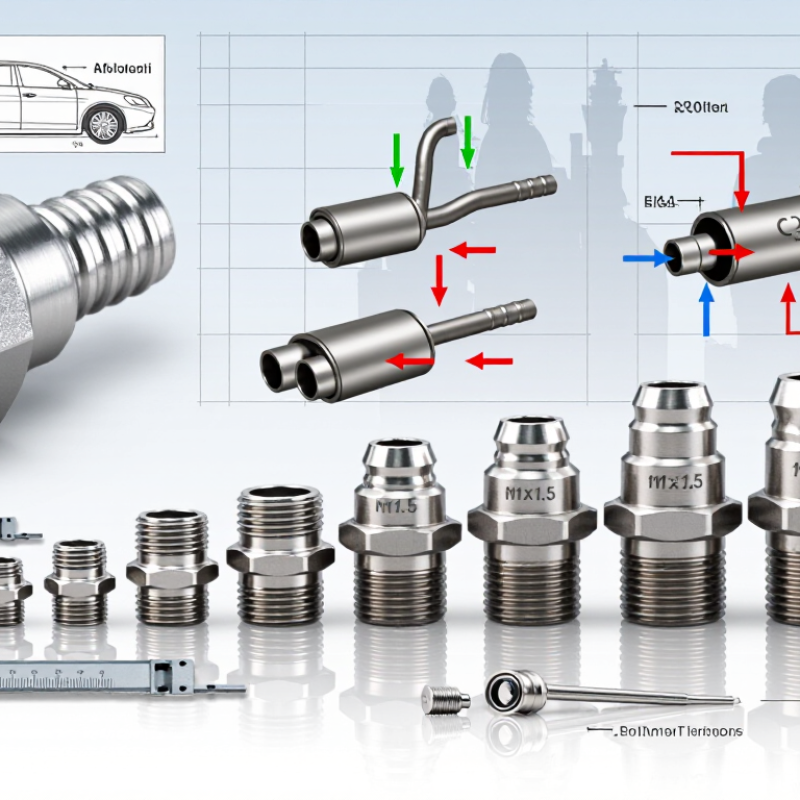
Table of Contents [Hide]
Oxygen Sensor Adapters Explained: M18×1.5 Threads and 0.1–0.9 V Signals
Choosing an oxygen sensor adapter starts with two specifications: M18×1.5 threads and a 0.1–0.9 V signal range. The thread size fits many conventional exhaust sensor locations, but thread matching alone is not enough. Confirm pitch, bung depth, shoulder clearance, and sensor tip exposure. A poorly positioned tip may read diluted exhaust gas. It can also contact condensation or internal tubing.
A zirconia narrowband sensor commonly switches between approximately 0.1 V and 0.9 V after reaching operating temperature. Around 0.45 V, the engine control system interprets the mixture near its switching point. The exact reading is not constant. Exhaust temperature, wiring resistance, heater performance, and leaks can change it. SAE service practices stress testing the complete circuit, not only the sensor output. The U.S. Environmental Protection Agency reported 93.5 million vehicles produced globally in 2023, showing why standardized replacement interfaces remain commercially important. Still, compatibility should be verified vehicle by vehicle.
In practical inspections, an M18×1.5 adapter should offer clean threads and sufficient wall thickness. Stainless steel is often preferred for heat and corrosion resistance, although material quality varies. Check for at least several full thread engagements. Avoid forcing a tight sensor. One small mistake matters. The International Organization of Motor Vehicle Manufacturers recorded more than 93 million new vehicles in 2023, yet many older combustion vehicles remain in service. This creates steady demand for reliable adapters, but a polished finish cannot replace dimensional testing. Measure voltage with a warmed engine, inspect for exhaust leaks, and question any reading that stays fixed.
China Top Oxygen Sensor Adapter Supplier How to Choose? - Oxygen Sensor Adapters Explained: M18×1.5 Threads and 0.1–0.9 V Signals
| Selection Dimension | Typical Specification or Fact | Why It Matters | Recommended Check |
|---|---|---|---|
| Thread size | M18 × 1.5 metric thread | This is a widely used oxygen-sensor thread format, but it is not universal for every vehicle or exhaust component. | Confirm the vehicle sensor port, adapter port, and sensor thread are all M18 × 1.5 before ordering. |
| Thread pitch | 1.5 mm between adjacent thread peaks | A different pitch can cause cross-threading, leakage, or permanent damage to the exhaust bung. | Use a thread gauge or compare the specification with the sensor and exhaust-bung documentation. |
| Sensor signal type | Conventional narrowband zirconia sensors commonly produce approximately 0.1–0.9 V. | The voltage range describes the sensor signal; it does not define the mechanical thread or guarantee compatibility with the vehicle ECU. | Verify whether the vehicle uses a narrowband voltage-output sensor or a wideband/current-pump sensor. |
| Wideband compatibility | Wideband oxygen sensors generally require dedicated control electronics and are not interchangeable with a simple 0.1–0.9 V input. | Using the wrong adapter or signal assumption may produce inaccurate air-fuel readings or fault codes. | Match the adapter application to the sensor technology and the controller or ECU input type. |
| Adapter material | Common choices include stainless steel and heat-resistant steel alloys. | The adapter is exposed to exhaust heat, thermal cycling, vibration, moisture, and corrosive combustion by-products. | Request the material grade, corrosion-resistance information, and intended exhaust-temperature range. |
| Wall thickness | Must be sufficient to retain the M18 × 1.5 thread under heat and vibration; the exact value depends on the adapter design. | Insufficient thread engagement or a weak wall can lead to stripped threads and exhaust leakage. | Check the engineering drawing for thread engagement, wall thickness, and dimensional tolerances. |
| Sensor tip clearance | The sensor tip should not contact the adapter, exhaust pipe, catalyst substrate, or internal baffle. | Insufficient clearance can damage the sensing element and restrict exhaust-gas exposure. | Compare the sensor length and tip position with the adapter’s internal cavity and installation depth. |
| Gas-flow design | Some adapters use a straight passage, while others use a diffuser, restrictor, or mini-catalyst structure. | The internal design can influence sensor response time, contamination exposure, and measured oxygen concentration. | Select the design according to the purpose: testing, sensor relocation, exhaust protection, or diagnostic applications. |
| Sealing method | Metal-to-metal thread fit is normally used; sealing requirements depend on the joint design and temperature. | An exhaust leak can draw in outside air and distort oxygen-sensor readings. | Follow the sensor and vehicle manufacturer’s instructions for thread sealant and tightening torque. |
| Heat resistance | The adapter should be rated for the expected exhaust location and thermal cycling conditions. | Excessive heat can cause distortion, thread seizure, coating failure, or premature cracking. | Ask for temperature limits and confirm suitability for pre-catalyst, post-catalyst, turbocharged, or naturally aspirated installation. |
| Electrical wiring | The adapter is primarily mechanical; sensor wiring, heater circuits, and connectors remain application-specific. | A correctly threaded adapter cannot compensate for incorrect wiring, grounding, heater control, or connector pinout. | Check the sensor wiring diagram and connector configuration separately from the adapter dimensions. |
| Dimensional quality | Important controls include thread accuracy, concentricity, flatness, burr removal, and surface finish. | Poor machining can make installation difficult and increase the risk of leakage or sensor damage. | Request inspection records, sample measurements, and a drawing showing critical tolerances. |
| Supplier evaluation | A reliable supplier should provide drawings, material information, sample verification, and traceable quality checks. | Clear technical documentation reduces fitment errors and makes repeat purchasing more consistent. | Compare technical support, inspection capability, customization options, packaging, lead time, and sample quality—not only price. |
Brands
Proudly Trusted by Top Suppliers Worldwide







Let us know and we will automate, together to fit your industrial needs.
 +91-97254 16844
Clients
Proudly Trusted by Top Companies Worldwide


Do you need Help? Get in touch.
X
Please fill out the form below and we will get back to you as soon as possible.