o
p
t
i
m
a
r
o
b
o
t
i
c
s

Make a Call


Make a Call
Blogs
China Best Abrasion Resistant Rubber Hose Manufacturer?
Choosing the best Abrasion Resistant Rubber Hose manufacturer in China requires more than comparing prices or catalog photographs. The right supplier must understand what the hose faces daily: sharp gravel, mineral slurry, cement dust, pressure surges, and repeated bending. A hose may look strong outside. Its tube, reinforcement, cover, and coupling design determine whether it survives real service.
Rubber technology expert Dr. James E. Mark offers a useful principle: “Material structure and formulation control performance.” This idea matters when evaluating Chinese manufacturers. A credible factory should explain its rubber compound, abrasion testing method, working pressure, temperature range, and reinforcement structure. It should also provide traceable inspection records. Standards such as ISO 4649 or DIN 53516 can support meaningful wear comparisons, although laboratory results never replace field experience.
Look closely at production details. Does the manufacturer test hose samples after vulcanization? Can it show batch records and coupling inspections? Does its engineering team recommend different designs for dry powder, wet slurry, or heavy aggregate? These questions reveal practical competence. Factory audits, customer references, and independent testing add further confidence.
The word “best” remains subjective. A supplier that excels in mining applications may not suit dredging or concrete pumping. Even a reputable factory can miss a defect. That is why trial orders, installation guidance, and after-sales support deserve attention. The strongest China-based manufacturer is not merely the cheapest option. It is the partner that connects compound science, controlled production, honest documentation, and proven performance in demanding environments.
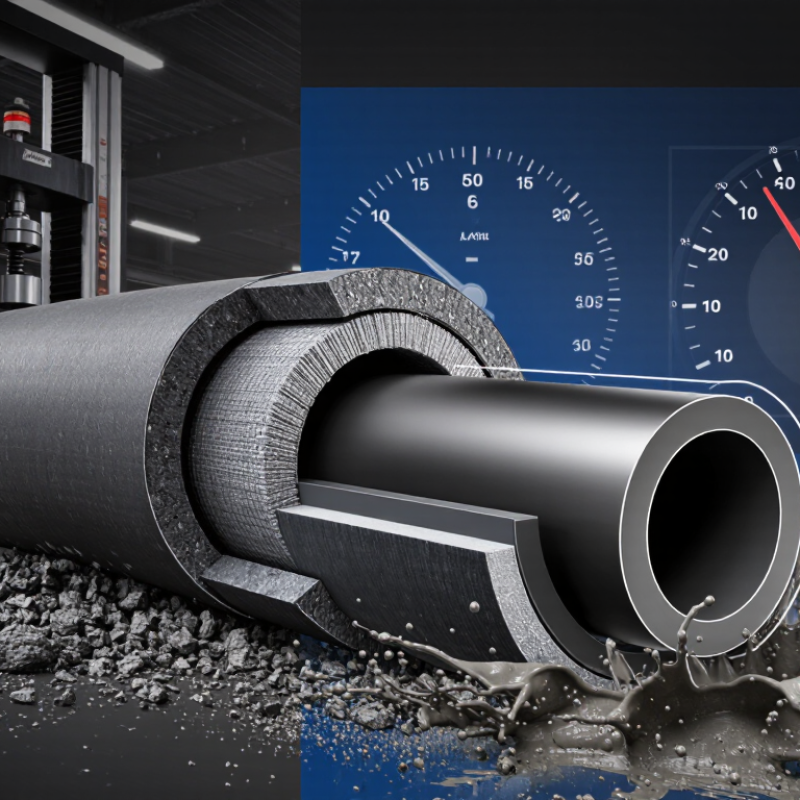
Table of Contents [Hide]
Abrasion Resistant Rubber Hoses: Definition, Structure, and Core Functions
Abrasion resistant rubber hoses are flexible pipelines designed to transport materials that wear down ordinary tubing. They handle slurry, sand, gravel, cement, and other abrasive mixtures. Their main value is longer service life under repeated friction. However, no hose suits every application.
A typical hose has three working layers. The inner tube uses dense, wear-resistant rubber to resist cutting and material impact. Textile or steel reinforcement supports internal pressure and prevents excessive stretching. The outer cover protects against sunlight, moisture, abrasion, and moderate mechanical damage. In practical operations, hose performance also depends on bend radius, pressure rating, temperature, and material concentration. A strong hose can still fail when installed too tightly. Field inspection often reveals overlooked twisting or unsupported weight.
Tips: Check the conveyed material before selecting a hose. Sharp particles need stronger abrasion resistance. Confirm pressure during start-up, not only normal operation. Keep the hose away from sharp edges and avoid forced bends. Inspect the inner wall regularly, because external surfaces may look acceptable while internal wear progresses. Recording service hours and failure locations improves future selection. This process is not perfect, but it provides useful evidence for safer replacement decisions.
Brands
Proudly Trusted by Top Suppliers Worldwide







Let us know and we will automate, together to fit your industrial needs.
 +91-97254 16844
Clients
Proudly Trusted by Top Companies Worldwide


Do you need Help? Get in touch.
X
Please fill out the form below and we will get back to you as soon as possible.