o
p
t
i
m
a
r
o
b
o
t
i
c
s

Make a Call


Make a Call
Blogs
What Is a PDU Switchboard and How Does It Work?
A Pdu Switchboard is more than a metal cabinet filled with breakers. It is a controlled power-distribution point that connects incoming electrical service with sensitive computing or industrial loads. In a typical data center, power may travel from utility service or generators through switchgear, transformers, and UPS systems before reaching the PDU Switchboard. Inside, busbars, circuit breakers, meters, and protection devices divide that power into safer, measurable circuits.
The numbers explain why this equipment deserves careful attention. The International Energy Agency’s Electricity 2024 report estimates that data centers consumed about 460 TWh globally in 2022. Their demand could exceed 1,000 TWh by 2026. Uptime Institute’s 2024 Global Data Center Survey also reported that 54% of respondents experienced an outage costing more than $100,000. Small distribution weaknesses can become expensive failures.
Patrick Donovan, a senior research analyst at Schneider Electric, describes the practical role simply: “A PDU distributes power to IT equipment.” That sentence is brief. The engineering is not. A well-designed PDU Switchboard balances phases, isolates faults, supports maintenance, and shows real-time load conditions. Technicians may inspect a warm breaker, a crowded cable entry, or a rising current reading before a failure develops. Yet a clean diagram can hide poor coordination. Ratings, short-circuit capacity, grounding, and monitoring settings must match the installation. This article explains how a PDU Switchboard works, where it fits in the power chain, and which design details deserve a second look.
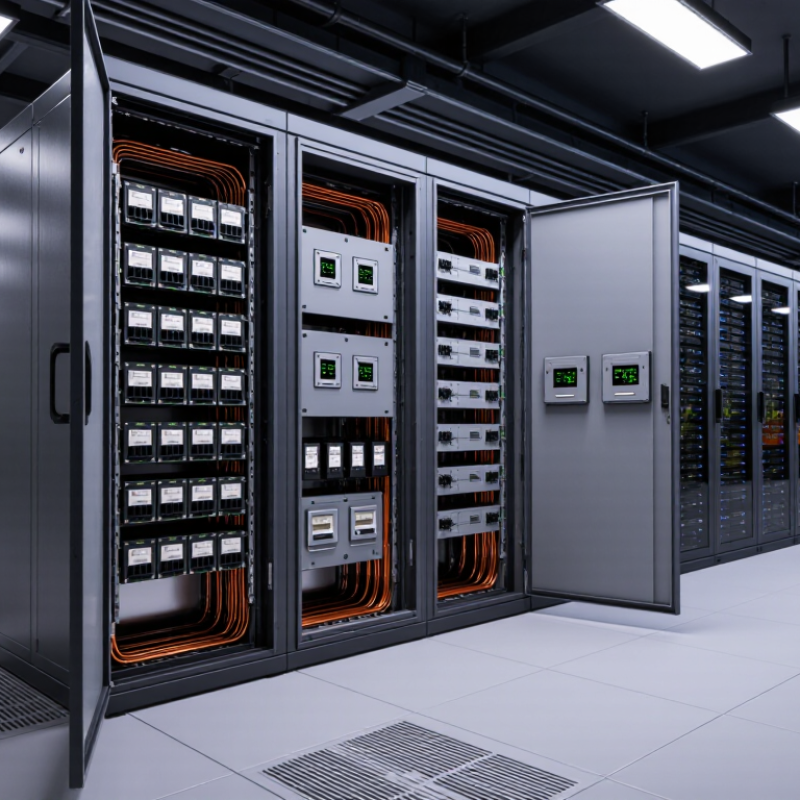
Table of Contents [Hide]
What Is a PDU Switchboard?
A PDU switchboard is an electrical distribution assembly that receives power and sends it safely to multiple downstream circuits. PDU means Power Distribution Unit. In a switchboard, the unit may include a main disconnect, circuit breakers, busbars, meters, and outgoing terminals. These parts are arranged inside a protected enclosure. The enclosure may stand near servers, industrial equipment, or other high-demand loads.
Its job is practical. Incoming power enters through the main connection. Protection devices interrupt faults or overloads. Busbars carry power across the cabinet, while branch breakers divide it into separate circuits. Meters can show voltage, current, energy use, or phase balance. Technicians may then identify an overloaded circuit before heat damages insulation. Clear labels and accessible cable routes also make inspection safer and faster.
The exact design depends on voltage, current, phase arrangement, grounding, and installation conditions. A PDU switchboard is not simply a larger power strip. It requires coordinated protection and careful load calculations. Naming can vary between industries, which sometimes creates confusion. A unit described as a switchboard may contain PDU functions, but not every PDU has full switchboard capability. That distinction deserves checking. In practice, engineers should verify breaker ratings, short-circuit capacity, enclosure protection, ventilation, and maintenance access. One overlooked detail can weaken an otherwise sound design. Human error remains possible, especially when labels are unclear or circuits change after installation.
Brands
Proudly Trusted by Top Suppliers Worldwide







Let us know and we will automate, together to fit your industrial needs.
 +91-97254 16844
Clients
Proudly Trusted by Top Companies Worldwide


Do you need Help? Get in touch.
X
Please fill out the form below and we will get back to you as soon as possible.