o
p
t
i
m
a
r
o
b
o
t
i
c
s

Make a Call


Make a Call
Blogs
What Is a Puree Pouch Filling Machine and How Does It Work?
A Puree Pouch Filling Machine is built for a deceptively difficult task: moving thick, smooth food into flexible pouches without splashing, leaking, or trapping air. Fruit puree, baby food, sauces, and yogurt-like products behave differently from free-flowing liquids. Their viscosity changes with temperature, fiber content, and processing conditions.
PMMI’s 2024 State of the Industry report identifies automation, labor availability, and flexible packaging as important machinery investment pressures. Smithers’ flexible packaging research also points to continued demand for lightweight, convenient formats. These trends help explain why pouch systems now appear across food, beverage, and nutrition production lines. The machine usually feeds empty pouches, opens them, doses a measured volume, seals the top, and removes finished packs. Some systems add nitrogen flushing, cleaning-in-place circuits, checkweighers, or vision inspection.
“It is a product-handling problem before it is a speed problem,” says Jorge Izquierdo, Vice President of Market Development at PMMI, describing a principle widely applied in automated packaging design. The wording is simple. The engineering is not.
A reliable Puree Pouch Filling Machine must control pump pressure, filling temperature, nozzle movement, and seal-jaw heat together. Even a small puree smear can weaken a seal. A few trapped air bubbles may distort the pouch. Minor errors become expensive at high output.
Still, the picture is not perfect. Reported machine speeds often depend on product flow, pouch material, and operator discipline. Laboratory results may not survive a busy factory floor. This guide examines how the equipment works, where failures begin, and which specifications deserve closer questioning before purchase.
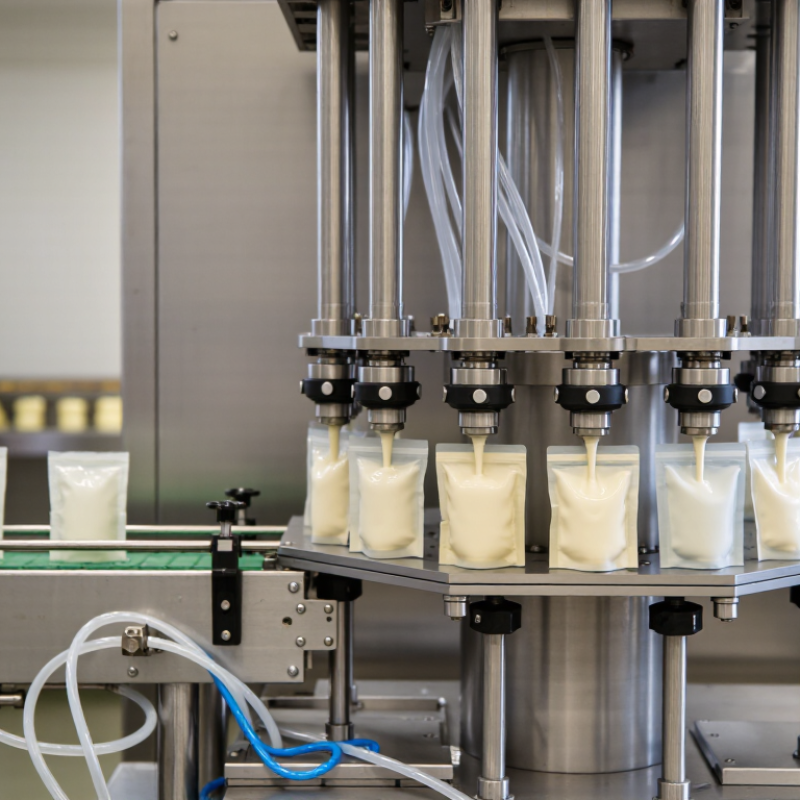
Table of Contents [Hide]
Definition and Purpose of a Puree Pouch Filling Machine
A puree pouch filling machine is industrial equipment designed to measure and seal smooth foods inside flexible pouches. It handles products such as fruit puree, vegetable blends, sauces, and baby food. Its main purpose is controlled packaging. Each pouch should receive a consistent amount with minimal product loss.
The process usually begins with a food-grade hopper holding the prepared puree. A pump or piston system moves the product toward the filling nozzle. Sensors help position each pouch before filling starts. The machine then dispenses a measured volume and seals the opening with heat or pressure. Sealing temperature, dwell time, and film condition must match the packaging material. Small errors can cause leaks.
Cleanability is equally important. Product-contact parts should be removable or easy to wash and inspect. Operators typically check fill weight, seal strength, temperature readings, and pouch appearance during production. These checks support traceability and reliable quality control. A machine may run quickly, but speed alone does not prove good performance. That matters.
The definition sounds simple, yet real operation is less predictable. Puree viscosity can change with temperature, fiber content, and recipe variation. A setting that works in the morning may need adjustment later. This is where practical experience becomes valuable. Operators must watch for dripping nozzles, uneven seals, trapped air, and underfilled pouches. Automation reduces repetitive work, but it does not remove the need for trained judgment. Mistakes still happen.
What Is a Puree Pouch Filling Machine and How Does It Work? - Definition and Purpose of a Puree Pouch Filling Machine
Brands
Proudly Trusted by Top Suppliers Worldwide





Let us know and we will automate, together to fit your industrial needs.
 +91-97254 16844
Clients
Proudly Trusted by Top Companies Worldwide


Do you need Help? Get in touch.
X
Please fill out the form below and we will get back to you as soon as possible.