o
p
t
i
m
a
r
o
b
o
t
i
c
s

Make a Call


Make a Call
Blogs
Why Choose a Skid Steer Loader for Your Business?
Choosing the right equipment can shape a small business’s daily productivity and long-term costs. A Skid Steer Loader offers compact power for construction, landscaping, agriculture, and property maintenance. Its short frame can turn inside a narrow backyard or move through a crowded jobsite. That flexibility matters.
Operators often value the quick-attach system, which supports buckets, forks, augers, trenchers, and sweepers. One machine can handle several tasks without requiring a large equipment fleet. This may reduce transport demands and storage pressure. However, attachments must match the loader’s rated operating capacity and hydraulic flow. Bigger is not always better.
Real-world performance depends on more than horsepower. Experienced contractors examine lift height, tipping load, visibility, cab comfort, tire type, and service access. A loader working on muddy ground needs different tires from one operating on finished pavement. Daily checks also matter, including hydraulic leaks, attachment pins, tire damage, and fluid levels. Small oversights become expensive repairs.
The financial decision deserves careful reflection. Purchase price, fuel use, insurance, maintenance, financing, and operator training all affect the actual return. Rental data from similar projects can reveal whether ownership makes sense. A reliable dealer should explain service intervals and provide clear specifications. Ask difficult questions.
There is no universal machine for every business. A compact model may improve access but sacrifice lifting capacity. A larger model may increase output but create transport and operating challenges. Review your typical jobsite, workload, and future plans before choosing. The best Skid Steer Loader is the one that performs consistently, safely, and profitably in your real working conditions.
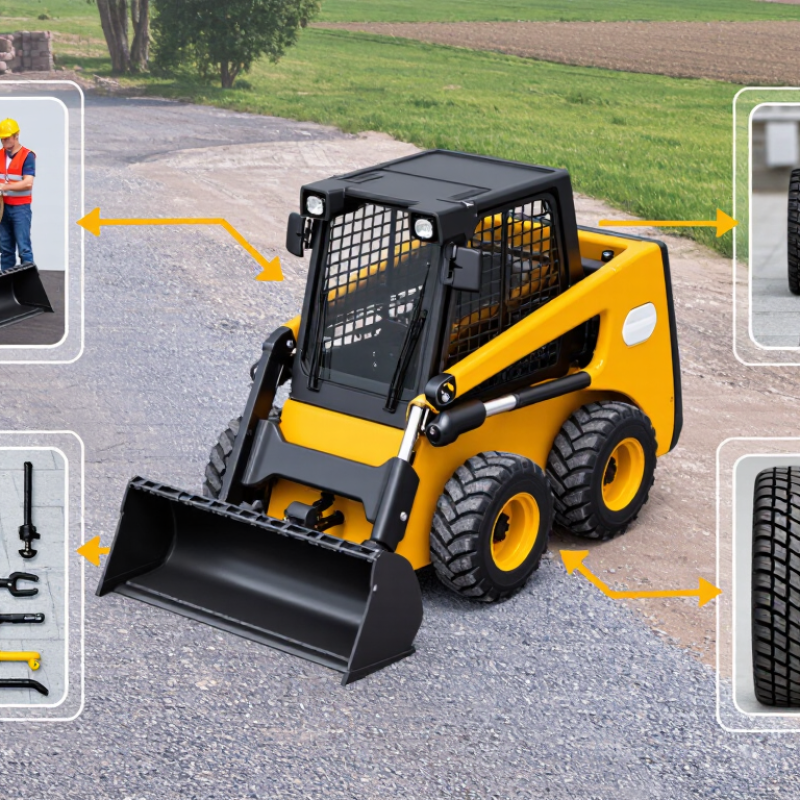
Table of Contents [Hide]
What Is a Skid Steer Loader and How Does It Work?
A skid steer loader is a compact machine built for tight construction, landscaping, farming, and utility sites. Its name describes the steering method. The left and right wheels or tracks move at different speeds, allowing the machine to turn by skidding across the ground. It can pivot within its own length. That is useful beside walls, fences, and narrow trenches.
The engine powers hydraulic pumps rather than a conventional mechanical drive. Hydraulic motors turn each side independently, while cylinders raise and tilt the lift arms. Operators can change attachments quickly, including buckets, augers, forks, and sweepers. Auxiliary hydraulic flow controls powered tools. According to ISO 14397-1, rated operating capacity is commonly based on 50% of the machine’s tipping load. That figure matters when lifting wet soil or dense aggregate. A larger bucket does not always mean better productivity.
Market evidence supports continued demand. Grand View Research estimated the global skid steer loader market at about 2.76 billion dollars in 2023, with projected growth through 2030. However, market size does not measure jobsite success. Fuel use, attachment matching, tire wear, and operator skill can change the result. A common mistake is treating the loader like a small excavator. It cannot safely replace every machine. Keep the load low during travel, check the attachment lock, and inspect hydraulic hoses before starting. Small oversights become expensive quickly.
Why Choose a Skid Steer Loader for Your Business? - What Is a Skid Steer Loader and How Does It Work?
| Data Dimension | Typical Information | Why It Matters to a Business |
|---|---|---|
| Machine Definition | A skid steer loader is a compact, rigid-frame loader that turns by driving the wheels or tracks on each side at different speeds or in opposite directions. | The compact design provides strong maneuverability in confined work areas such as construction sites, farms, warehouses, and landscaping projects. |
| Steering Method | Skid steering: the wheels or tracks on the left and right sides operate independently, allowing the machine to pivot within a very small turning area. | Reduced turning space can improve productivity where conventional loaders or trucks cannot maneuver efficiently. |
| Typical Rated Operating Capacity | Approximately 450–3,500 kg, depending on machine size, configuration, and manufacturer rating. Actual safe capacity must be checked in the equipment specifications. | Helps determine whether the loader can safely handle the materials, attachments, pallets, or tools required for the job. |
| Operating Weight | Common operating weights range from about 2,500 kg for compact units to more than 5,500 kg for larger models. | Weight affects transportation requirements, ground pressure, stability, and suitability for work on finished surfaces. |
| Engine Power | Typical engine output is approximately 35–110 kW, with larger machines generally providing more hydraulic flow and lifting capability. | Power selection influences digging performance, travel ability, fuel use, and the range of attachments the loader can operate. |
| Hydraulic System | Hydraulic pumps deliver pressurized fluid to the lift arms, bucket, and auxiliary attachments. Standard-flow systems are commonly around 50–90 L/min, while high-flow systems may exceed 100 L/min. | Hydraulic flow and pressure determine whether the loader can power demanding tools such as planers, breakers, trenchers, and brush cutters. |
| Lift-Arm Design | Vertical-lift arms travel upward with a relatively vertical path; radial-lift arms follow an arc that can provide useful reach at mid-height. | Vertical lift is often preferred for truck loading and high reach, while radial lift can suit digging and work close to the ground. |
| Attachment Compatibility | Common attachments include buckets, pallet forks, augers, trenchers, sweepers, grapples, hydraulic breakers, snow blades, and rotary cutters. | One power unit can perform multiple tasks, potentially reducing the need to purchase and store several specialized machines. |
| Ground Contact Options | Wheeled models generally offer faster travel and lower operating cost on firm surfaces. Compact track loaders provide lower ground pressure and improved traction on soft or uneven terrain. | Choosing wheels or tracks affects surface protection, mobility, traction, maintenance, and seasonal operating flexibility. |
| Typical Travel Speed | Many standard models travel at approximately 10–12 km/h; two-speed configurations may reach roughly 18–20 km/h, depending on the machine. | Higher travel speed can reduce cycle time when the worksite requires frequent movement between loading, stockpiling, and transport areas. |
| Turning Clearance | Because the machine turns by sliding or skidding its tires or tracks, it can rotate in a compact space, although the exact clearance depends on the loader and attachment. | Useful for indoor demolition, narrow lanes, residential construction, and landscaping areas with limited room. |
| Fuel or Energy Use | Fuel consumption varies widely with engine size, load, hydraulic demand, surface conditions, attachment, and operator technique. Manufacturer test data should be used for project costing. | Accurate consumption estimates support pricing, job costing, rental decisions, and return-on-investment calculations. |
| Best-Suited Applications | Material handling, grading, excavation, site cleanup, utility work, snow removal, landscaping, agricultural work, and attachment-based specialty tasks. | Broad application coverage can improve equipment utilization throughout the year and across different types of contracts. |
| Main Business Advantages | Compact footprint, high maneuverability, attachment versatility, simple jobsite transport compared with larger loaders, and strong productivity for its size. | These characteristics can help small and medium-sized businesses handle varied work with a flexible equipment fleet. |
| Important Limitations | Skid steering can disturb finished surfaces, the cab may experience more vibration during turns, and operating capacity is limited by machine stability and attachment weight. | A site assessment is essential before use on delicate paving, steep slopes, soft ground, or projects requiring high lifting height. |
| Selection Checklist | Evaluate rated operating capacity, tipping load, lift height, hydraulic flow, attachment requirements, operating surface, transport limits, service access, and operator safety features. | Matching specifications to actual tasks helps avoid underpowered equipment, excessive operating costs, and unsafe working conditions. |
| Overall Business Fit | A skid steer loader is a strong choice when a business needs a compact, versatile machine for frequent short-cycle tasks and multiple attachment types. | The best value comes from high annual utilization, suitable attachments, trained operators, and careful matching of machine size to project requirements. |
Note: Specifications are indicative industry ranges. Exact performance, capacity, dimensions, and operating costs vary by machine configuration, attachment, worksite, and manufacturer data.
Brands
Proudly Trusted by Top Suppliers Worldwide





Let us know and we will automate, together to fit your industrial needs.
 +91-97254 16844
Clients
Proudly Trusted by Top Companies Worldwide


Do you need Help? Get in touch.
X
Please fill out the form below and we will get back to you as soon as possible.