o
p
t
i
m
a
r
o
b
o
t
i
c
s

Make a Call


Make a Call
Blogs
Why Choose an Electric Hoist Winch for Global Sourcing?
When buyers source lifting equipment across borders, price alone rarely protects a project. An Electric Hoist Winch must match the load, lift height, duty cycle, workplace temperature, and available power supply. Small mismatches can cause delays, unsafe operation, or expensive modifications at installation. Details matter. Experienced procurement teams examine rated capacity, brake performance, drum or chain design, pendant controls, and emergency stopping features. They also request test records, clear manuals, traceable components, and realistic delivery commitments. These checks create a stronger basis for comparing suppliers.
Global sourcing adds practical questions beyond product specifications. Will the voltage suit the site? Can replacement parts arrive quickly? Does the supplier explain maintenance intervals in plain English? A reliable manufacturer should provide drawings, inspection data, warranty terms, and responsive technical support. Independent verification can strengthen confidence, especially when samples look similar but internal components differ. Site experience shows why this matters: a hoist may lift smoothly during a short demonstration, then struggle under repeated industrial cycles. Performance must be judged over time.
Choosing an Electric Hoist Winch is therefore a balance between capability, supplier transparency, service access, and total operating cost. The cheapest quotation may not be the economical choice. That assumption deserves scrutiny. Freight damage, unclear documentation, weak training, or unavailable spare parts can quietly increase ownership costs. No supplier removes every risk. Buyers should compare verified evidence, ask difficult questions, and record acceptance requirements before ordering. Some evaluations remain imperfect because real working conditions are difficult to reproduce. Still, disciplined sourcing helps purchasers select equipment that performs reliably and supports safer, more predictable operations worldwide.
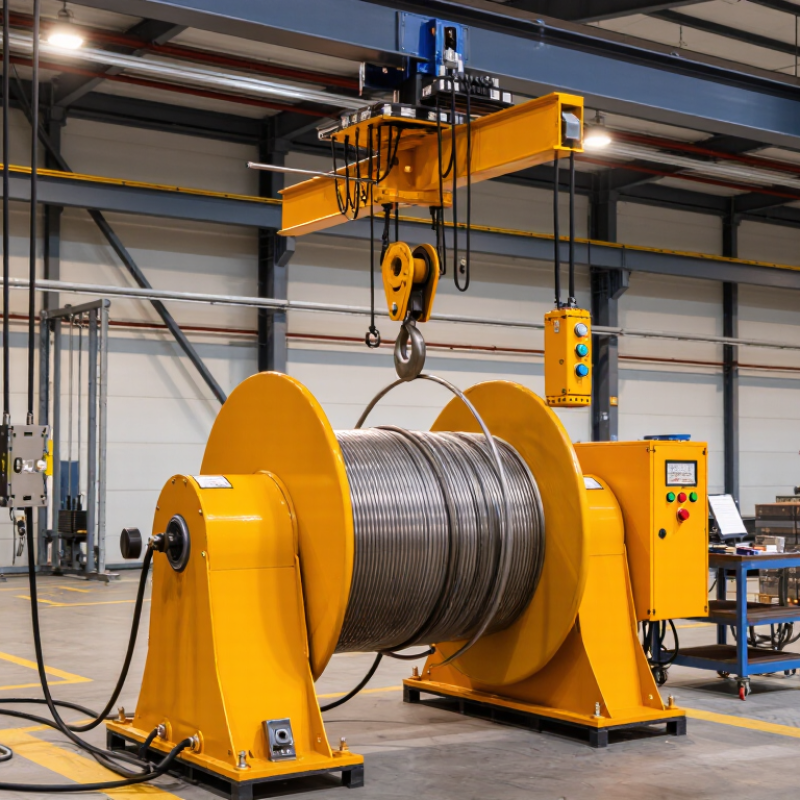
Table of Contents [Hide]
What Is an Electric Hoist Winch?
An electric hoist winch is a powered lifting device for raising, lowering, or positioning heavy loads. It uses an electric motor, gearbox, brake, and either wire rope or load chain. A drum or pocket wheel stores and moves the lifting medium. Operators usually control it with a pendant, push buttons, or a remote transmitter.
The terms “hoist” and “winch” overlap in commercial descriptions. Technically, a hoist mainly lifts loads vertically, while a winch often pulls horizontally. Some electric hoist winches perform both tasks. That distinction matters during global sourcing. Buyers should check rated capacity, lifting speed, duty class, voltage, control protection, and emergency braking. ISO 4301 classification helps evaluate crane and hoisting equipment duty cycles. ASME B30.16 also provides guidance for overhead hoists.
The equipment is not automatically safe because it is electric. The U.S. Bureau of Labor Statistics recorded 1,032 fatal injuries in transportation and material-moving occupations in 2023. This broader category includes many handling activities, not only hoist operations, but the figure deserves attention. Inspection routines, load testing, limit switches, and trained operators remain essential. Product claims can be unclear across markets. A careful buyer should request test certificates, wiring diagrams, and maintenance records before comparing prices. Energy use also deserves review. The International Energy Agency reported that global electricity demand grew by 4.3% in 2024. Efficient motors may reduce operating costs, but real savings depend on load cycles, standby time, and local electricity conditions.
Why Choose an Electric Hoist Winch for Global Sourcing? - What Is an Electric Hoist Winch?
| Data Dimension | Typical Technical Data | Why It Matters for Global Sourcing |
|---|---|---|
| Product Definition | An electrically powered lifting and pulling device that uses a motor, gearbox, drum or chain mechanism, wire rope or load chain, hook, brake, and control system. | A clear definition helps buyers compare like-for-like products and avoid confusing a hoist with a simple pulling winch or manually operated lifting device. |
| Main Operating Principle | The electric motor converts electrical energy into rotary motion. The gearbox reduces speed and increases torque to lift or pull a load in a controlled manner. | The motor and gearbox specification directly affects lifting speed, load capacity, service life, noise, and maintenance requirements. |
| Rated Lifting Capacity | Common industrial capacities range from approximately 125 kg to 10,000 kg for standard electric chain or wire-rope hoists. Higher capacities require specialized designs. | The rated capacity must exceed the maximum working load. Buyers should also consider load distribution, lifting accessories, impact loading, and the required safety factor. |
| Typical Lifting Speed | Electric chain hoists commonly operate at approximately 2–8 m/min. Wire-rope hoists may offer higher speeds, often around 3–12 m/min depending on capacity and configuration. | Higher speed can improve productivity, but a lower-speed or dual-speed configuration may provide better positioning accuracy and load control. |
| Power Supply | Industrial models commonly use three-phase AC power such as 380–415 V at 50 Hz or 400–480 V at 60 Hz. Single-phase options are also available for lighter-duty equipment. | Voltage, frequency, phase, plug type, and control voltage must match the destination country and installation site before purchasing. |
| Duty Classification | Duty ratings are based on lifting frequency, operating time, load spectrum, and average load. Common standards include FEM and ISO classifications, while regional markets may use other equivalent systems. | A higher capacity alone does not guarantee suitability. The duty class should match the expected daily cycles and workload to prevent overheating and premature wear. |
| Control Options | Typical controls include pendant push-button stations, wireless remote controls, upper and lower limit switches, emergency-stop circuits, and optional variable-frequency drives. | Control selection affects operator safety, positioning accuracy, installation complexity, and compatibility with automated material-handling systems. |
| Braking System | Most industrial electric hoists use an automatic electromagnetic or mechanical load brake designed to hold the load when power is removed. | Buyers should verify brake holding performance, emergency stopping behavior, brake wear inspection procedures, and the availability of replacement parts. |
| Safety Features | Common features include overload protection, emergency stop, upper and lower limit switches, thermal motor protection, a safety latch on the hook, and a load chain or wire-rope guide. | Safety equipment should be confirmed against the regulations and lifting standards applicable in the destination market, rather than accepted only from a product brochure. |
| Lifting Medium | Electric chain hoists use calibrated load chain and are generally compact. Wire-rope hoists use steel wire rope and are commonly selected for greater lifting heights or heavier industrial loads. | The choice affects installation space, lifting height, inspection requirements, maintenance, noise level, and total operating cost. |
| Lifting Height | Standard configurations often provide approximately 3–12 m of lift. Longer lift heights can be supplied when the drum, chain container, rope length, and mounting structure are correctly sized. | The required hook travel should be measured from the highest to the lowest operating position, including clearance for the hook and load-handling accessories. |
| Installation Configurations | Available arrangements may include fixed suspension, trolley-mounted installation, monorail operation, bridge-crane integration, wall mounting, or a custom support frame. | The mounting method determines headroom, runway requirements, wheel loads, structural reinforcement, and installation cost. |
| Efficiency and Productivity | Electric operation provides consistent lifting speed and repeatable control while reducing manual effort compared with hand chain or lever-operated equipment. | For repetitive material handling, electric power can reduce operator fatigue and improve throughput, especially when the duty cycle and maintenance plan are properly matched. |
| Environmental Protection | Enclosures are commonly specified using IP ratings. Many indoor models use moderate protection levels, while outdoor, dusty, or wet environments require appropriately rated motors, controls, and electrical components. | The buyer should specify dust, moisture, temperature, corrosion, and hazardous-area conditions before selecting the enclosure and electrical configuration. |
| Operating Temperature | Many standard electric hoists are designed for moderate industrial temperatures, often approximately −20°C to +40°C. Extreme temperatures require suitable lubricants, insulation, seals, or heating systems. | Climate compatibility is essential for international projects because temperature, humidity, and storage conditions can vary significantly between regions. |
| Maintenance Requirements | Routine tasks include checking the hook, brake, chain or wire rope, gearbox lubrication, limit switches, electrical connections, fasteners, and abnormal noise or vibration. | A supplier should provide inspection intervals, service documentation, wear limits, spare-parts lists, and troubleshooting instructions in the buyer’s required language. |
| Compliance Documentation | Typical documents may include a user manual, wiring diagram, load test record, inspection certificate, declaration of conformity where applicable, and technical datasheet. | Complete documentation supports customs clearance, workplace compliance, commissioning, operator training, and future maintenance. |
| Load Testing | Lifting equipment is normally subject to functional checks and rated-load testing according to the applicable local regulations, standards, and inspection procedures. | The purchase specification should identify who performs the test, which standard applies, what records are supplied, and whether third-party inspection is required. |
| Total Cost of Ownership | Total cost includes the equipment price, trolley or mounting structure, electrical installation, shipping, import duties, commissioning, inspections, spare parts, energy use, and downtime. | Comparing only the initial purchase price can lead to higher long-term costs if the hoist has unsuitable duty classification, poor parts availability, or inadequate service support. |
| Key Sourcing Checks | Confirm capacity, lift height, lifting speed, duty class, voltage, phase, frequency, control type, mounting method, ambient conditions, safety features, documentation, and warranty terms. | A complete technical checklist reduces specification errors, improves quotation comparability, and helps ensure that the selected electric hoist winch is suitable for safe operation in the destination market. |
Brands
Proudly Trusted by Top Suppliers Worldwide





Let us know and we will automate, together to fit your industrial needs.
 +91-97254 16844
Clients
Proudly Trusted by Top Companies Worldwide


Do you need Help? Get in touch.
X
Please fill out the form below and we will get back to you as soon as possible.