o
p
t
i
m
a
r
o
b
o
t
i
c
s

Make a Call


Make a Call
Blogs
Why Choose a Natural Gas Boiler for Global Buyers?
For global buyers, a Natural Gas Boiler can offer a practical balance between heating performance, fuel availability, and installation flexibility. The Energy Institute’s Statistical Review of World Energy 2024 reported that natural gas supplied about 22% of global primary energy consumption in 2023. This broad infrastructure base supports procurement in many industrial, commercial, and residential markets. However, availability differs sharply between regions.
Efficiency matters. The U.S. Department of Energy states that high-efficiency condensing gas boilers can achieve roughly 90% to 98% annual fuel utilization efficiency. In real installations, that performance depends on return-water temperature, controls, pipe insulation, and regular servicing. A well-adjusted boiler should respond quietly, maintain stable water temperatures, and avoid repeated short cycling. Small technical choices affect long-term operating costs.
The International Energy Agency’s World Energy Outlook 2024 indicates that natural gas demand remains significant during the energy transition, although future growth will vary by policy and market. This makes gas equipment relevant, but not universally optimal. Buyers must examine fuel prices, emissions rules, ventilation requirements, spare-parts access, and local technician expertise before selecting a system. Methane leakage also deserves attention; the IEA’s Global Methane Tracker 2024 identifies fossil-fuel operations as a major methane source. That concern cannot be ignored.
No boiler is perfect. A Natural Gas Boiler may reduce installation complexity today, yet create future compliance pressure. Careful lifecycle assessment, verified efficiency data, and realistic maintenance planning can help buyers choose with greater confidence.
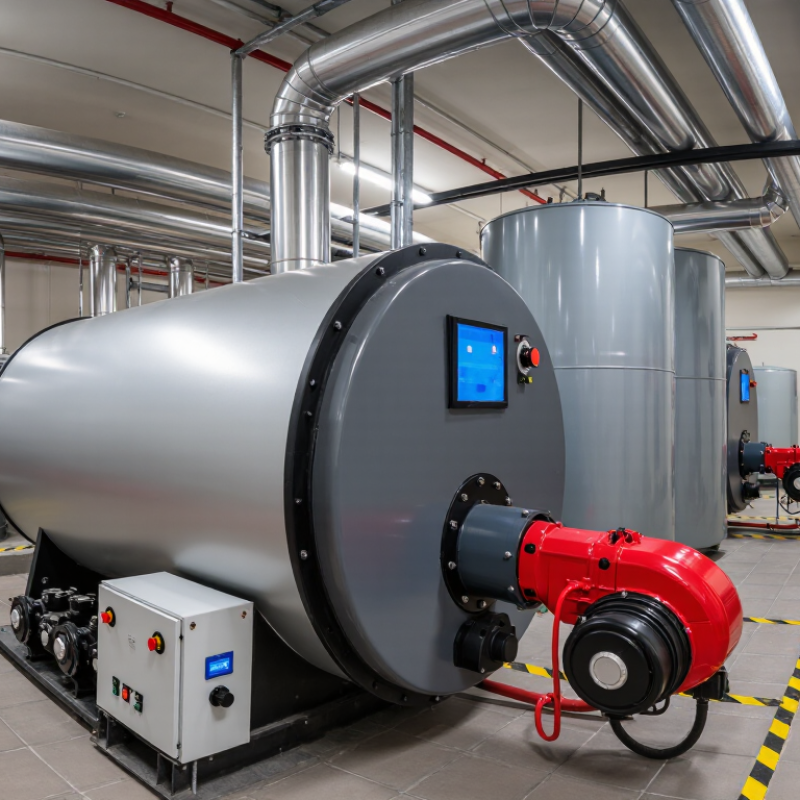
Table of Contents [Hide]
What Is a Natural Gas Boiler and How Does It Work?
A natural gas boiler heats water by burning gas inside a controlled combustion chamber. The fuel enters a sealed burner, where an ignition system creates a stable flame. Heat then passes through a metal heat exchanger. The warmed water moves through pipes to radiators, underfloor loops, or a hot water cylinder. Simple in principle.
A thermostat measures room temperature and sends signals to the boiler controls. The system adjusts the burner and pump to match demand. In a condensing model, cooler return water helps recover heat from water vapor in the exhaust. This can improve efficiency. A flue safely releases remaining gases outdoors. Sensors monitor temperature, pressure, and flame quality during operation. Real buildings are less tidy.
From practical installation experience, correct sizing matters more than impressive product figures. An oversized boiler may start and stop repeatedly, wasting energy and increasing component wear. Global buyers should check local gas pressure, fuel quality, certification rules, and service availability before purchasing. A qualified technician should test combustion, seals, ventilation, and flue performance during commissioning. Annual inspection remains important, even when the boiler appears quiet and reliable. I would not treat efficiency ratings as guaranteed results. Poor pipe design, weak insulation, or incorrect controls can reduce actual performance. No system is perfect.
Brands
Proudly Trusted by Top Suppliers Worldwide







Let us know and we will automate, together to fit your industrial needs.
 +91-97254 16844
Clients
Proudly Trusted by Top Companies Worldwide


Do you need Help? Get in touch.
X
Please fill out the form below and we will get back to you as soon as possible.