o
p
t
i
m
a
r
o
b
o
t
i
c
s

Make a Call


Make a Call
Blogs
What Is a Universal Robot Arm and How Does It Work?
A universal robot arm is a programmable robotic system designed to handle different tasks across factories, laboratories, warehouses, and workshops. Unlike a fixed-purpose machine, it can change tools, movements, and production routines through software. A technician may guide its wrist by hand, attach a gripper, and teach a precise path within minutes. That flexibility explains its growing role in modern automation.
The International Federation of Robotics reported 541,302 industrial robots installed worldwide in 2023. Its World Robotics 2024 report also recorded more than four million industrial robots operating globally. These figures show strong demand, but they do not make every robot suitable for every workplace. Payload, reach, speed, safety functions, and integration costs still matter. A small universal robot arm may lift only a few kilograms, while heavier systems require guarded work zones and stronger foundations. The details decide the result.
Esben Østergaard, co-founder of Universal Robots, expressed the human-centered vision clearly: “People should work with robots, not like robots.” That idea captures the appeal of collaborative automation. Sensors can detect contact, while software limits force and speed near workers. However, safety is not automatic. Risk assessments, training, maintenance, and correct programming remain essential. A robot can repeat a bad instruction perfectly. That is the uncomfortable part.
This guide explains how a universal robot arm senses movement, receives commands, controls its joints, and completes practical tasks. It also examines real costs, technical limits, and common implementation mistakes. The technology is powerful, but not magical.
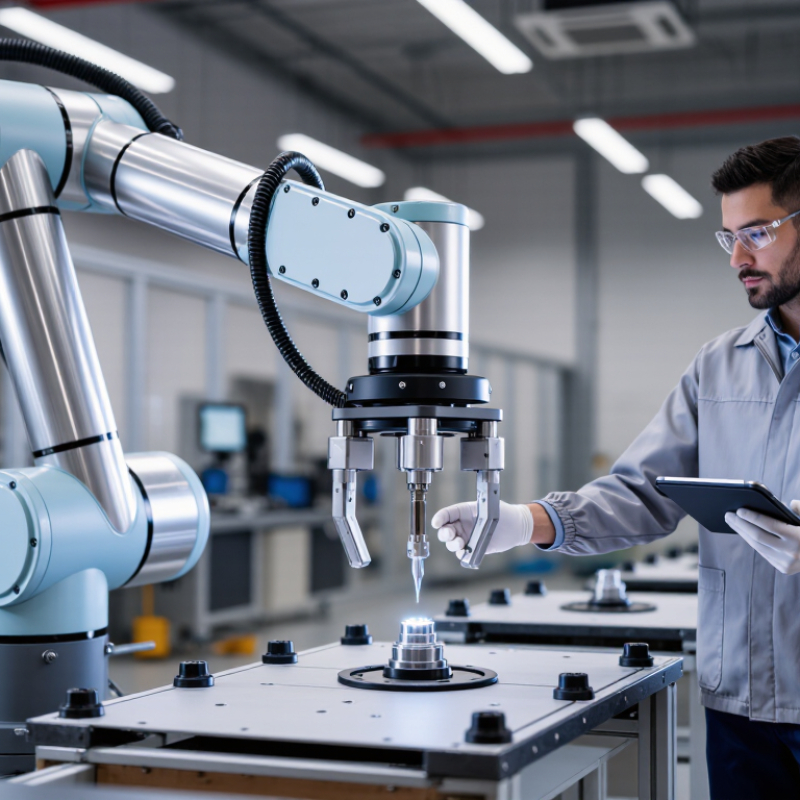
Table of Contents
[Hide]
What a Universal Robot Arm Is and What Makes It Different
What Is a Universal Robot Arm and How Does It Work?
A universal robot arm is a programmable machine designed for many different tasks. It can move, pick, place, weld, inspect, or assemble parts. Its joints use electric motors, gear systems, and position sensors. A controller coordinates these movements through software. An operator can teach points, adjust speed, and change the end tool without rebuilding the entire workstation.
The word universal can mislead. The arm is not suitable for every job. Its real strength is flexibility. A fixed industrial robot may repeat one process at high speed, while a universal arm can move between smaller production tasks. It usually has a compact structure and several rotating joints. This helps it reach awkward positions beside a workbench. It may also use force sensing, which helps detect contact during handling or assembly. Not quite human-like.
In practical installations, setup quality matters as much as the arm itself. A technician must check payload, reach, cycle time, tool weight, and workspace risks. Safety features do not remove the need for guarding, testing, and worker training. The arm may appear simple after programming, but small errors can cause poor alignment or dropped parts. A practical lesson is clear: flexible does not mean effortless. Reliable performance comes from measured trials, clear procedures, and regular inspection. Universal robot arms are different because they can adapt, but their limits still require honest evaluation.
Related Posts
-
Top 10 Universal Robot Arm Applications You Need to Know?
-
How to Choose the Right Universal Robot Arm for Your Automation Needs?
-
Top 10 Universal Robot Arm Options for Global Buyers?
-
Best Universal Robot Arm for Efficient Automation Solutions?
-

How to Choose Collaborative Robots in 2026?
-
Why Choose a Universal Robot Arm for Automation?
Brands
Proudly Trusted by Top Suppliers Worldwide



Let us know and we will automate, together to fit your industrial needs.
 +91-97254 16844
Clients
Proudly Trusted by Top Companies Worldwide


Do you need Help? Get in touch.
X
Please fill out the form below and we will get back to you as soon as possible.